

Make sure you know the exact annual payment rate on your loan since the method of calculation and number of compounding periods can have an impact on your monthly payments. While banks and financial institutions have standardized methods to calculate interest payable on mortgages and other loans, the calculations may differ slightly from one country to the next. https://personal-accounting.org/ The commonly used compounding schedule for savings account at a bank is daily. For a CD, typical compounding frequency schedules are daily, monthly or semi-annually; for money market accounts, it’s often daily. For home mortgage loans, home equity loans, personal business loans, or credit card accounts, the most commonly applied compounding schedule is monthly.
Bankrate
That’s led to a slew of warnings that government borrowing will crowd out private investment and jack up interest rates even more. “If you borrow money — through a credit card, a mortgage, or an auto loan — you could end up paying the price,” The New York Times ominously warned. Compound interest works best over the course of many years. What starts as even a small investment could, over decades, result in exponential growth in your employees’ 401 accounts. Encourage them to consider how saving now can help them tap into the power of interest and grow their retirement savings.
Borrowing Money Becomes Difficult
For example, if you’ve saved for 25 years and have a $1 million portfolio, a 4% investment return will yield $40,000 annually. You don’t have to save any more of your own money out of pocket because the Compound Interest Definition snowball effect will likely take care of your savings goals for you. So in these later years you’ll see big gains from focusing on lowering investment costs and sticking with a good investment strategy.
The effective annual interest rate is the real return on an investment, accounting for the effect of compounding over a given period of time. The Rule of 72 calculates the approximate time over which an investment will double at a given rate of return or interest “i” and is given by (72 / i). It can only be used for annual compounding but can be very helpful in planning how much money you might expect to have in retirement. The more often an investment compounds, the faster it grows. For instance, if you have $1,000 invested at 6 percent and it compounds yearly, you’ll have $1,060 after one year and $1,123.60 after two.
Research Online Investment Firms
How do you solve compound interest problems quickly?
Bank accounts earn compound interest (Many checking accounts pay no interest at all. You can also earn compounded interest in money market accounts and certificates of deposit (CDs).
Even a modest level of savings that is allowed to grow over a period of many years can grow into a significant sum of money. Compound Interest Definition Considered a safe investment, certificates of deposit are issued by banks and generally offer higher interest than savings.
Low interest rates also negatively affect people who live off the interest income from their savings, so they cut back their spending. When a large group of people, such as baby boomer retirees, reduce their spending, overall economic activity slows. Within a 401 plan, savings grow when they are invested into funds composed of stocks and bonds.

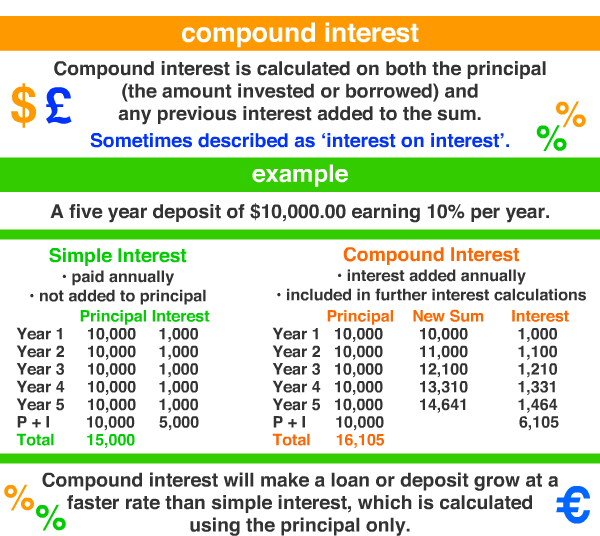
The rate at which compound interest accrues depends on the frequency of compounding, such that the higher the number of compounding periods, the greater the compound interest. Thus, the amount of compound interest accrued on $100 compounded at 10% annually will be lower than that on $100 compounded at 5% semi-annually over the same time period. Since the interest-on-interest effect can generate increasingly positive returns based on the initial principal amount, it has sometimes been referred to as the “miracle of compound interest.”
Three Big Factors About Car Loans
As they mature, you get both the principal and the interest. Your money is tied up in these CDs until your account reaches maturity, but if you don’t need the income right away, these are a safe investment.
Yearly Vs. Monthly Vs. Daily
- Make sure you know the exact annual payment rate on your loan since the method of calculation and number of compounding periods can have an impact on your monthly payments.
- While banks and financial institutions have standardized methods to calculate interest payable on mortgages and other loans, the calculations may differ slightly from one country to the next.
- The commonly used compounding schedule for savings account at a bank is daily.
A liquidity trap happens when interest rates are so low that they don’t serve the normal function of spurring the economy to growth. Instead, they reduce the flow of money to the Main Street economy because it goes into investments in assets that don’t produce employment, such as the stock market and paying down loans. This means money doesn’t flow through the economic system. When that happens, unemployment rises as companies lay off expensive workers and hire contractors and temporary or part-time workers at lower prices. When wages decline, people can’t pay for things and prices on goods and services are forced down, leading to more unemployment and lower wages.
Think Big.”Aim for a $500 to $1000 emergency fundto start if you don’t have one, and grow and replenish it as needed. Most experts recommend a balance of three to six months worth of living expenses for an adequate emergency fund. Once you’ve established at least a $500 fund to cushion your finances in emergencies, it’s time to begin paying down debt.
You want your money to work for you in the best, most efficient way possible. To do this, compare interest rates, account balances, and outcomes.
It is applied regularly to savings accounts or loans according to various compounding methods. Consider a mutual fund investment opened with an initial $5,000 and an annual addition of $2,400. With an average of 12% annual return of 30 years, the future value of the fund is $798,500.
Banks have lots of money in their deposit accounts, attracted by high interest rates, so they are eager to lend to you. Low interest rates also affect insurance companies https://personal-accounting.org/compound-interest-definition/ that rely on a certain interest-based return on the money they receive in premiums to support their coverage liabilities, so your insurance premiums may rise.
It’s this “interest paid on interest” that causes the snowball affect—or compounding—that rapidly grows your wealth. The reason that Investor A comes out ahead is the effect of compounded earnings over time. Investor A has given her account Compound Interest Definition an extra 10 years to grow, and the compounded returns that the account experiences actually outweigh any future contributions that are given less time to grow. Starting early gives you the best chance to save for a secure retirement.
Of course, the better your investment returns, the faster your money will grow but in these later years, even a solid 3% or 4% annual rate of return will yield impressive results. If you’re like most of us, you probably wish you could have a lot more money with a lot less effort. Luckily, there’s a simple way to accomplish this if you’re willing to learn how to put your money to work for you. It’s called compound interest, which is calculated on your initial principal and also on the accumulated interest of previous periods.
This is the danger of deflation, which is difficult to stop as the economy spirals down. That said, annual interest is normally at a higher rate because of compounding. Instead of paying out monthly the sum invested has twelve months of growth. But if you are able to get the same rate of interest for monthly payments, as you can for annual payments, then take it. There are many 401 savings calculators available, and all of them demonstrate how your retirement account balance can grow over time.
On average, the stock market has returned somewhere around 10% annually since 1926. While the exact number can fluctuate from year to year, an average return this high has the potential to significantly grow the money you contribute to your 401 account. The most basic form of interest is simple interest, which is a little less complex Compound Interest Definition than compound interest. Where compound interest considers both the initial amount of money saved or borrowed plus any interest gained since the start, simple interest only deals with that original deposit or loan. It’s easy to visualize how simple interest functions on a savings deposit of $10,000 with an interest rate of 5% per year.
We pay interest on credit card purchases and loans, and we earn interest on our savings and investments. There are different types of interest, however, and one form—compound interest—can result in exponential growth over time. For your employees who participate in your 401, this is the form of interest that helps make their retirement savings expand over the years. Let’s talk about compound interest, how it differs from simple interest, and what role the concept of compound interest plays in a 401 plan.
HIGHLY RECOMMENDED

Cleanse